What Would Bayes Do
for Next-Gen Neural Network Design?



Images by me (2019) & by Nano Banana 2 (gemini-3.1-flash-image, 2026)
pre-ChatGPT (- 2022)
AGI (when?)
1
Build network architectures
with Bayesian principles
Build Bayesian procedures
on frontier models
Many of you have contributed wonderful works in these developments ☺
\[(t_{2i-1},t_{2i})=(\mathbf{x}_i,\mathbf{y}_i)\]
\[(t_{2n+1},t_{2n+2})=(\mathbf{x}^{*},\mathbf{y}^{*})\]
\[{\color[RGB]{32,76,154}p(\mathbf{y}_i\mid\mathbf{x}_i,\mathbf{x}_{<i},\mathbf{y}_{<i})=p_{\phi}^{2i}(t_{2i}\mid t_{1:2i-1})}\]
\[{\color[RGB]{180,86,21}p(\mathbf{y}^{*}\mid\mathbf{x}^{*},\mathcal{D})=p_{\phi}^{2n+2}(t_{2n+2}\mid t_{1:2n+1})}\]
In-context learning & predictive resampling
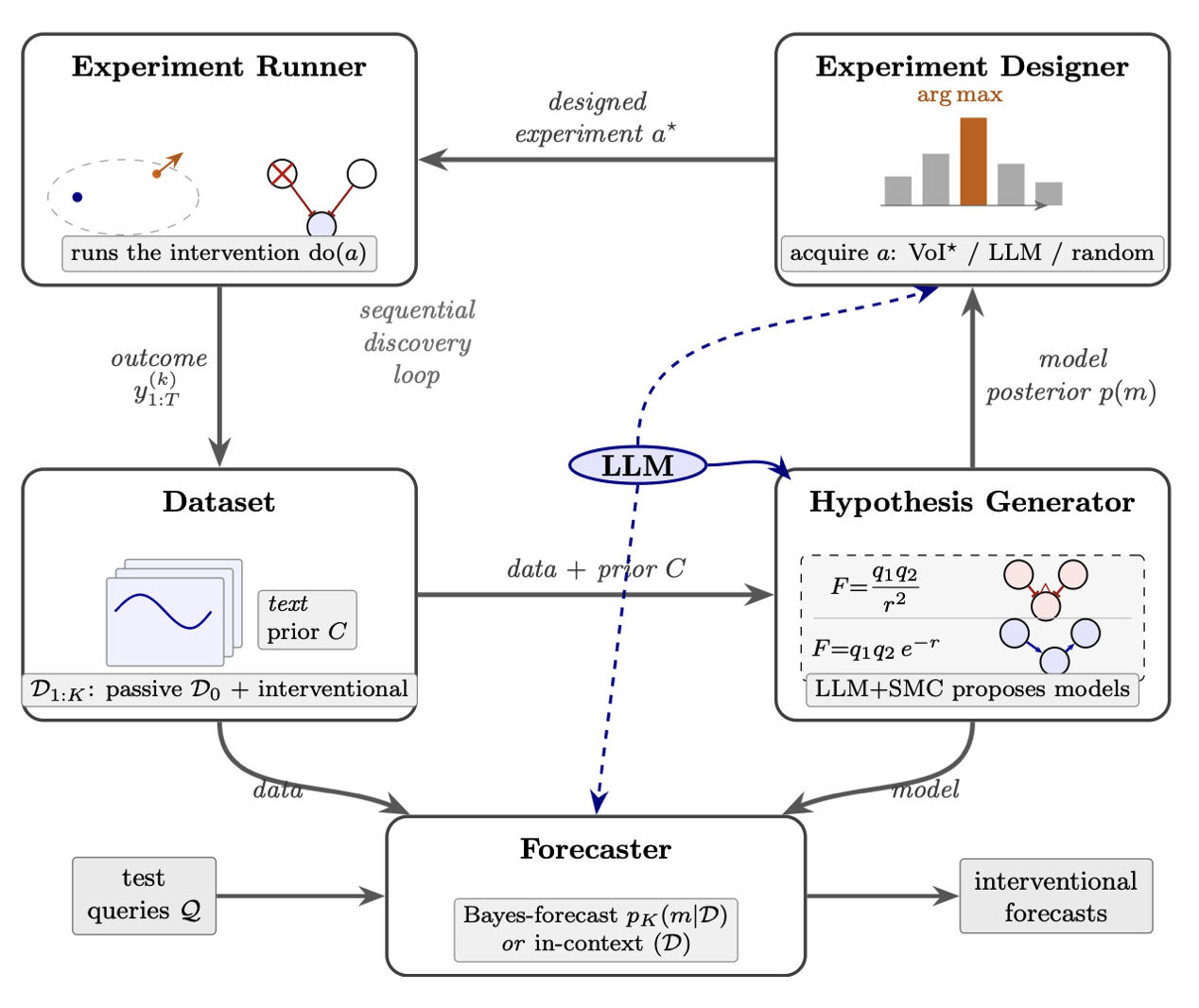
Agentic AI: Bayesian pipeline
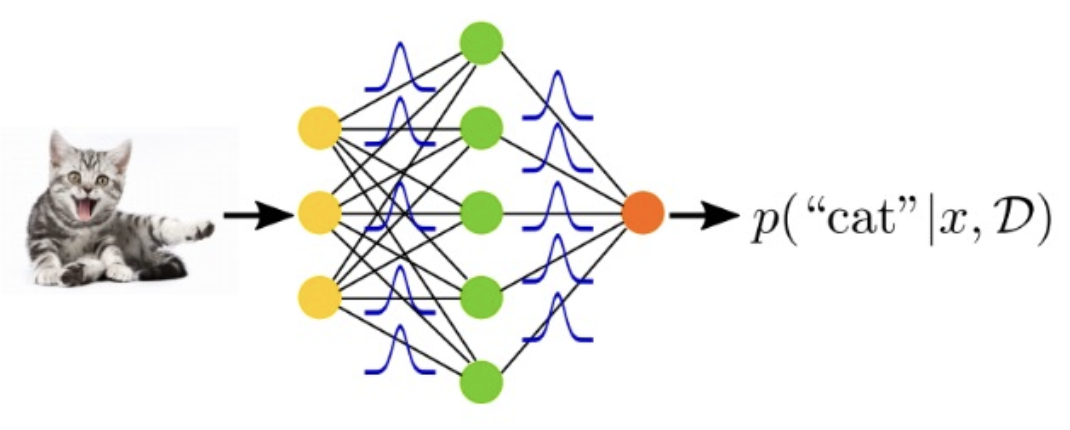
Bayesian NNs: weight/function-space posterior inference
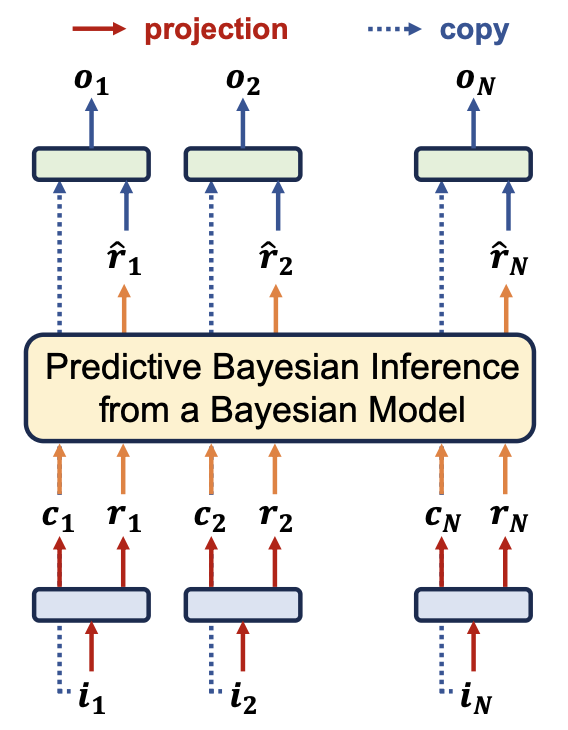
NN layer design with Bayesian principles
MLSys work needed
(mostly absent now!)
”Modernization” via ”Bayesian LoRA” (?)
Entrée: Uncertainty quantification
Main: Memory updates & maintenance
2
Naoki Kiyohara
Harrison Bo Hua Zhu
Riccardo El Hassanin

Wenlong Chen
Work led by my amazing current/former PhD students
Idea 1: Leverage probabilistic models to improve the “reliability” of attention-based Transformers (e.g., ”reliable uncertainty”)
Sparse Gaussian Process Attention
- a Deep GP tailored to Transformer architectures
Chen and Li, ICLR 2023,
Calibrating Transformers via Sparse Gaussian Processes.
3
Wenlong Chen
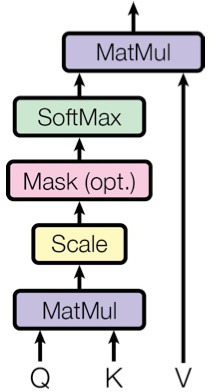
Vaswani et al. Attention is all you need. NeurIPS 2017
Tsai et al. Transformer dissection: A unified understanding for transformer’s attention via the lens of kernel. EMNLP 2019
Single head attention
Attention matrix
Replace attention matrix with kernel matrix:
\[Attention(\mathbf{q},\mathbf{k},\mathbf{v})={\color[rgb]{0,0,1}activation(\mathbf{q}\mathbf{k}^{\top})}\mathbf{v}\]
\[KernelAttention(\mathbf{q},\mathbf{k},\mathbf{v})={\color[rgb]{0,0,1}\mathbf{K}_{\mathbf{qk}}}\mathbf{v}\]
4
Kernel Attention:
\[\mathbf{F}={\color[rgb]{0,0,1}\mathbf{K}_{\mathbf{qk}}}{\color[rgb]{1,0,0}\mathbf{v}}\]
Recall posterior mean of SVGP:
Equivalent by identifying:
q (queries) = x (queried input locations)
k (keys) = z (inducing locations)
v (values) = (variational parameters)
\[[{\color[rgb]{0,0,1}\mathbf{K}_{\mathbf{qk}}}]_{ij}\]
similarity between and
\[\mathbf{q}_i\]
\[\mathbf{k}_j\]
Chen and Li. Calibrating Transformers via Sparse Gaussian Processes. ICLR 2023
5
is a free-parameter, is invertible
=> Can optimize as a free-parameter
\[\boldsymbol{\Sigma}^{(post)}=\mathbf{K}_{\mathbf{qq}}+\mathbf{K}_{\mathbf{qk}}(\mathbf{K}_{\mathbf{kk}}^{-1}{\color[rgb]{1,0,0}\mathbf{S}}\mathbf{K}_{\mathbf{kk}}^{-1}-\mathbf{K}_{\mathbf{kk}}^{-1})\mathbf{K}_{\mathbf{kq}}\]
\[\mathbf{m}^{(post)}={\color[rgb]{0,0,1}\mathbf{K}_{\mathbf{qk}}}{\color[rgb]{1,0,0}\mathbf{v}}\]
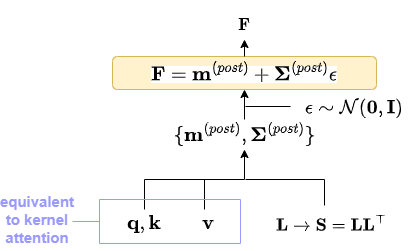
Chen and Li. Calibrating Transformers via Sparse Gaussian Processes. ICLR 2023
6
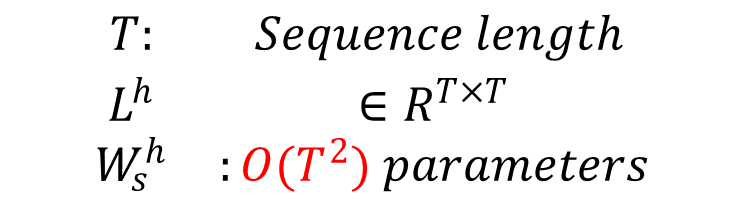
Chen and Li. Calibrating Transformers via Sparse Gaussian Processes. ICLR 2023
7
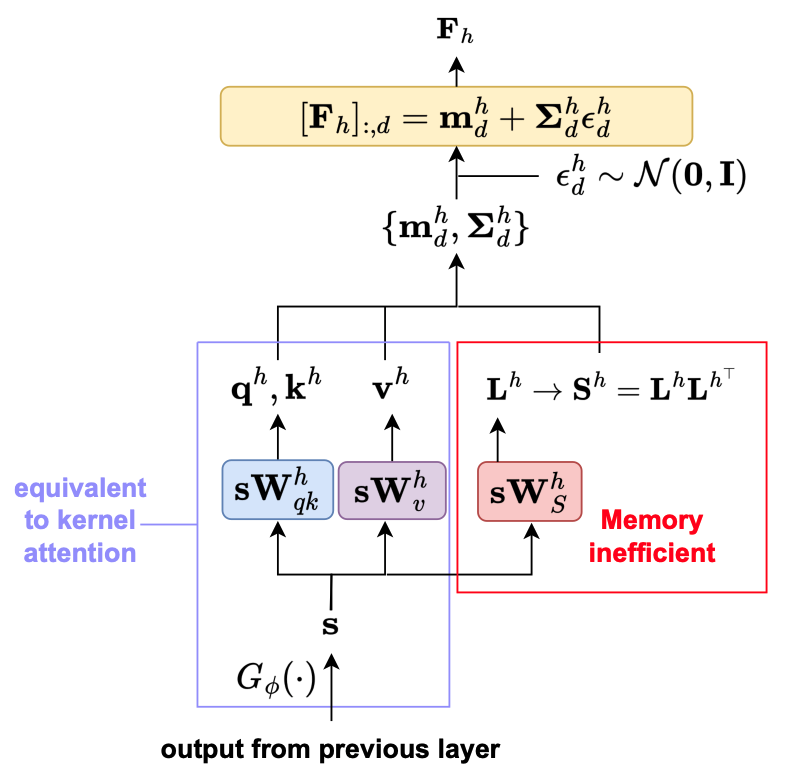

Chen and Li. Calibrating Transformers via Sparse Gaussian Processes. ICLR 2023
Cheng and Boots. Variational Inference for Gaussian Process Models with Linear Complexity. NIPS 2017

8
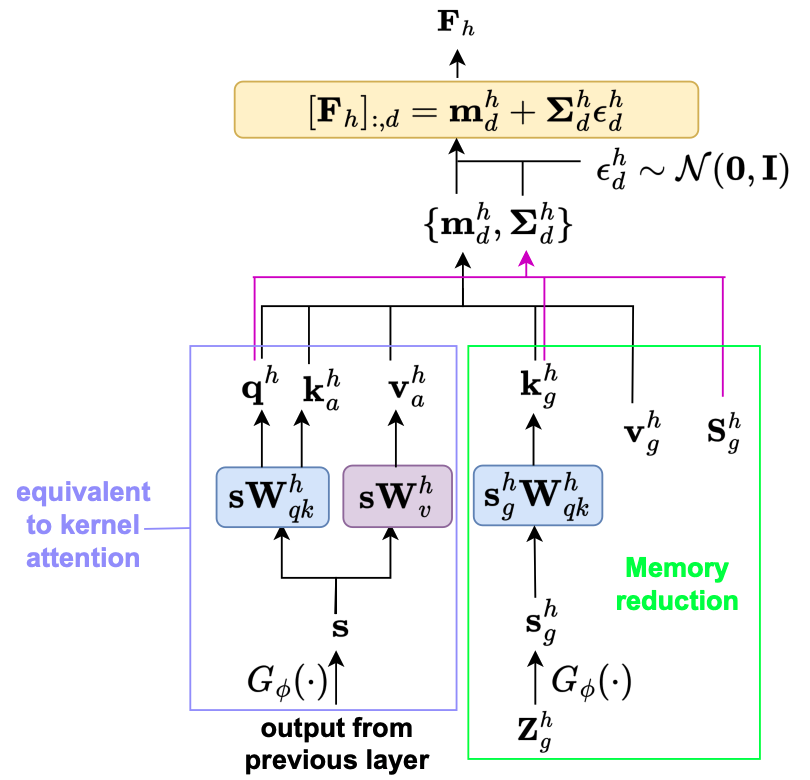

Chen and Li. Calibrating Transformers via Sparse Gaussian Processes. ICLR 2023
9
\[\widehat{Y}=\mathbb{1}\{H[\hat{p}]>\tau\}\]
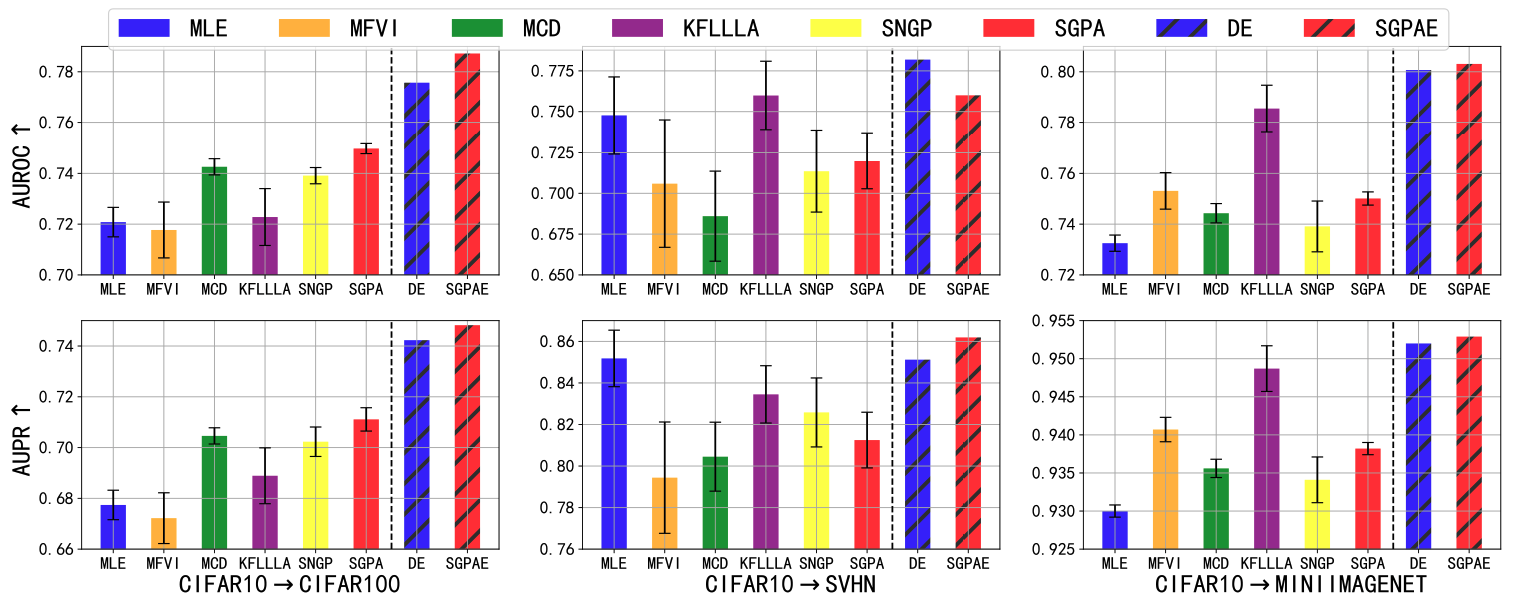
ViTs trained on CIFAR10
Kernel attention = mean of SVGP
So can think about how GP methods inspire memory design
SGPA = Deep Sparse GP modernised with Transformer arch.
So still fall in the traditional BNN category
Evaluations on calibration & OOD detection
Frequentist methods are computationally simpler and competitive here
Chen and Li. Calibrating Transformers via Sparse Gaussian Processes. ICLR 2023
10
Idea 2:
Exploit the kernel interpretation of attention;
Introduce interdomain methods for ”memory maintenance”
Interdomain Attention
– a hybrid attention that implicitly approximate attention with recurrent memory
Kiyohara et al., In submission,
Interdomain Attention:
Beyond Token-Level Key-Value Memory.
11
Naoki Kiyohara
Harrison Bo Hua Zhu
Riccardo El Hassanin
Wenlong Chen
12
1. Prefill (parallel compute)
Use the last output token as input
Read from KV cache for
Compute and write in KV cache, and compute with query , :
The output propagates and leads to generated token
\[o_i=\frac{\sum_{n=1}^{N}\mathcal{K}(q_i,k_n)\,v_n}{\sum_{n^{\prime}=1}^{N}\mathcal{K}(q_i,k_{n^{\prime}})}\]
2. Decode (sequential compute)
LLM “inference” compute in two stages:
User provides prompt token sequence
Compute in parallel
Cache as memory (KV cache)
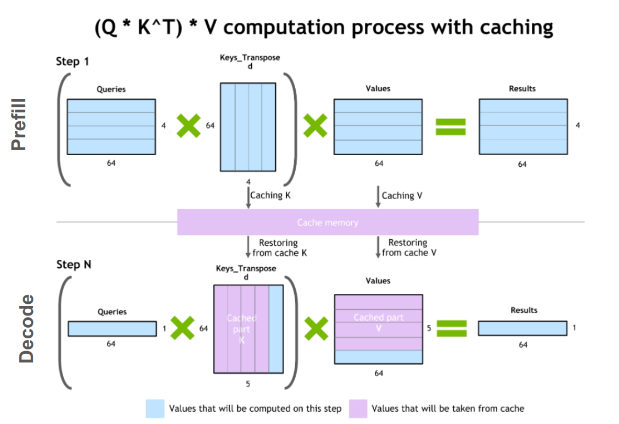
Growing memory size…
13
Consider approximating kernel as dot-product of features
\[\mathcal{K}(q,k)\approx\xi(q)^{\top}\xi(k)\]
\[o_i=\frac{\sum_{n=1}^{N}\mathcal{K}(q_i,k_n)\,v_n}{\sum_{n^{\prime}=1}^{N}\mathcal{K}(q_i,k_{n^{\prime}})}\]
The output of the attention procedure (with query ):
\[o_i\approx\hat{o}_i=\frac{\sum_{n=1}^{N}\xi(q_i)^{\top}\xi(k_n)\,v_n}{\sum_{n^{\prime}=1}^{N}\xi(q_i)^{\top}\xi(k_{n^{\prime}})}\]
Idea in a nutshell:
Step 1: Construct memory for
Step 2: “reconstruct” from the memory
Step 3: Plug-in the “reconstructions” to perform attention
Steps 2 & 3 can be done together!
(no explicit reconstruction & attention)
Kiyohara et al. Interdomain Attention: Beyond Token-Level Key-Value Memory. In submission
14
Key idea: function projection as memory
\[o_i\approx\hat{o}_i=\frac{\sum_{n=1}^{N}\xi(q_i)^{\top}\xi(k_n)\,v_n}{\sum_{n^{\prime}=1}^{N}\xi(q_i)^{\top}\xi(k_{n^{\prime}})}\]
Step 1.1. Treat the keys and values as functions of time
Step 1.2. Project key features and values onto a set of basis functions :
\[{\color[RGB]{76,134,37}u_m^{(t_N)}=\int\xi(k(t))\,\phi_m^{(t_N)}(t)\,dt}\]
\[{\color[RGB]{32,76,154}\gamma_m^{(t_N)}=\int v(t)\,\phi_m^{(t_N)}(t)\,dt}\]
Step 2 + 3 (virtual): Reconstruct the key features
+ perform attention (assume we have the values )
\[{\color[RGB]{76,134,37}\xi(k_n)\approx\sum_m u_m\,\phi_m(t_n)}\]
discretized sum (up to const.)
reconstruct
Kiyohara et al. Interdomain Attention: Beyond Token-Level Key-Value Memory. In submission
15
Key idea: function projection as memory
\[o_i\approx\hat{o}_i=\frac{\sum_{n=1}^{N}\xi(q_i)^{\top}\xi(k_n)\,v_n}{\sum_{n^{\prime}=1}^{N}\xi(q_i)^{\top}\xi(k_{n^{\prime}})}\]
Step 1.1. Treat the keys and values as functions of time
Step 1.2. Project key features and values onto a set of basis functions :
\[{\color[RGB]{76,134,37}u_m^{(t_N)}=\int\xi(k(t))\,\phi_m^{(t_N)}(t)\,dt}\]
\[{\color[RGB]{32,76,154}\gamma_m^{(t_N)}=\int v(t)\,\phi_m^{(t_N)}(t)\,dt}\]
\[{\color[RGB]{180,86,21}\eta_m^{(t_N)}=\int\phi_m^{(t_N)}(t)\,dt}\]
Step 2 + 3 (virtual): Reconstruct the key features
+ perform attention (denominator, optional)
\[{\color[RGB]{76,134,37}\xi(k_n)\approx\sum_m u_m\,\phi_m(t_n)}\]
discretized sum (up to const.)
reconstruct
Kiyohara et al. Interdomain Attention: Beyond Token-Level Key-Value Memory. In submission
16
Key idea: function projection as memory
\[o_i\approx\hat{o}_i=\frac{\sum_{n=1}^{N}\xi(q_i)^{\top}\xi(k_n)\,v_n}{\sum_{n^{\prime}=1}^{N}\xi(q_i)^{\top}\xi(k_{n^{\prime}})}\]
Step 1.1. Treat the keys and values as functions of time
Step 1.2. Project key features and values onto a set of basis functions :
\[{\color[RGB]{76,134,37}u_m^{(t_N)}=\int\xi(k(t))\,\phi_m^{(t_N)}(t)\,dt}\]
\[{\color[RGB]{32,76,154}\gamma_m^{(t_N)}=\int v(t)\,\phi_m^{(t_N)}(t)\,dt}\]
Step 2 + 3: Implement reconstruction + approximate attention in one go!
\[{\color[RGB]{180,86,21}\eta_m^{(t_N)}=\int\phi_m^{(t_N)}(t)\,dt}\]
\[F_q=[\xi(q_1),\ldots,\xi(q_{N_q})]^{\top}\]
\[{\color[RGB]{76,134,37}U=[u_1,\ldots,u_M]^{\top}}\]
\[{\color[RGB]{49,110,165}\Gamma=[\gamma_1,\ldots,\gamma_M]^{\top}}\]
\[{\color[RGB]{180,86,21}\eta=[\eta_1,\ldots,\eta_M]^{\top}}\]
query features
“KV” memory
Helper terms
Kiyohara et al. Interdomain Attention: Beyond Token-Level Key-Value Memory. In submission
Lázaro-Gredilla and Figueiras-Vidal. Inter-domain Gaussian Processes for Sparse Inference using Inducing Features. NIPS 2009
17
How to construct this function projection in an online manner?
SVGP approximate posterior mean:
is a free-parameter, is invertible
=> Can optimize as a free-parameter
Interdomain inducing points: projections on orthogonal basis functions:
(RFF approx.)
Plug-in to the mean computation, with :
(reconstruct )
()
(rewrite matrix-vector product)
Legendre polynomial
“Memorising” a function via projection to finite basis:
u – coefficients of projected to
Can be viewed as a finite-dim memory for a function (infinite-dim object)
18
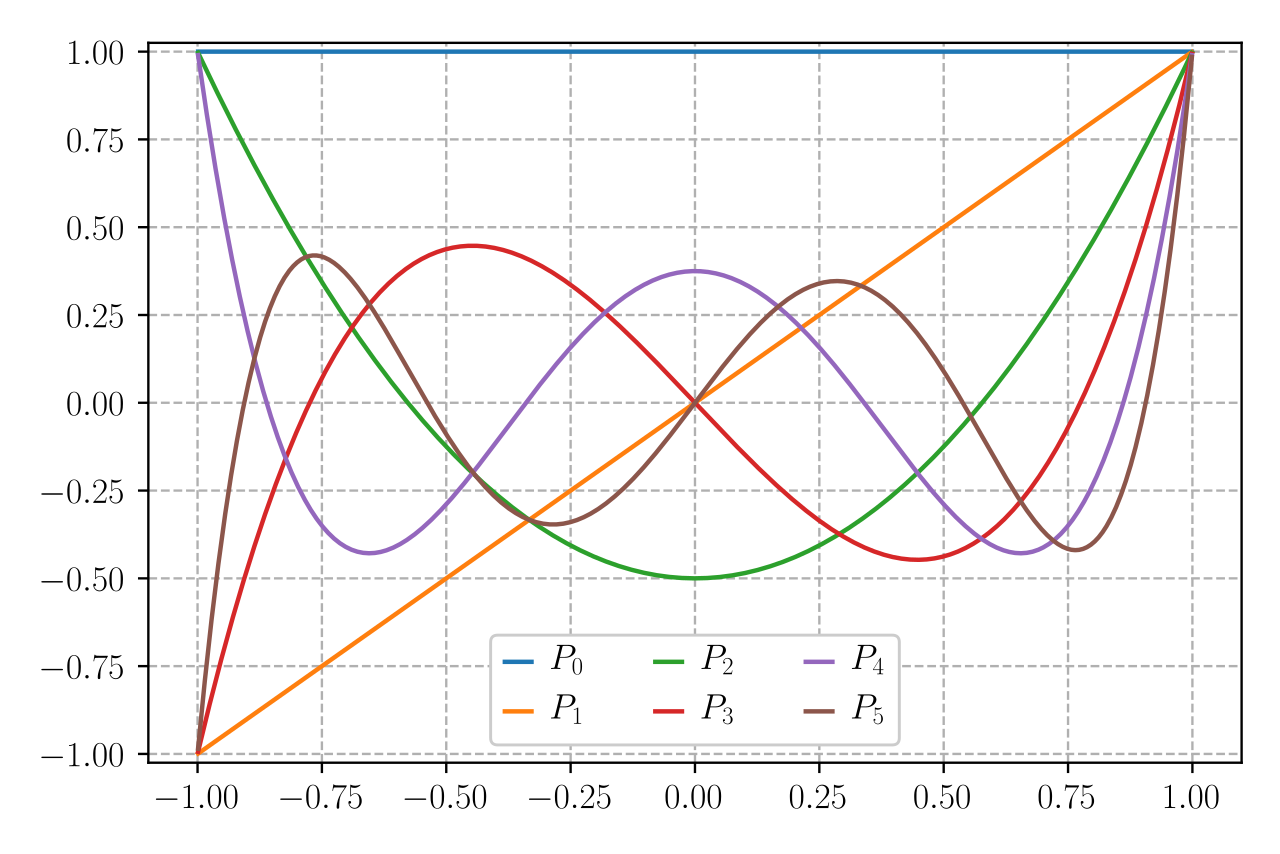
Fig: wikipedia
Gu et al. Recurrent Memory with Optimal Polynomial Projections. NeurIPS 2020
“Memorising” a function via projection to finite basis:
– coefficients of projected to
Rescaled Legendre polynomial
0
t
1/t
0
Can be viewed as a finite-dim memory for a function (infinite-dim object)
Memory “evolves” when increases!
19
Gu et al. Recurrent Memory with Optimal Polynomial Projections. NeurIPS 2020
: -th coefficient
: Target function for
: Normalised & scaled -th basis
: Normalised measure (mask)
20
20
Gu et al. Recurrent Memory with Optimal Polynomial Projections. NeurIPS 2020
The evolution of over time follows linear ODE:
We can obtain the coefficients
as a summary of the function up to time t in an online manner.
Input sequence to memorize
Specific matrix and vector corresponding to function basis and measure
Gu et al. Recurrent Memory with Optimal Polynomial Projections. NeurIPS 2020
21
Gu et al. Recurrent Memory with Optimal Polynomial Projections. NeurIPS 2020
22
23
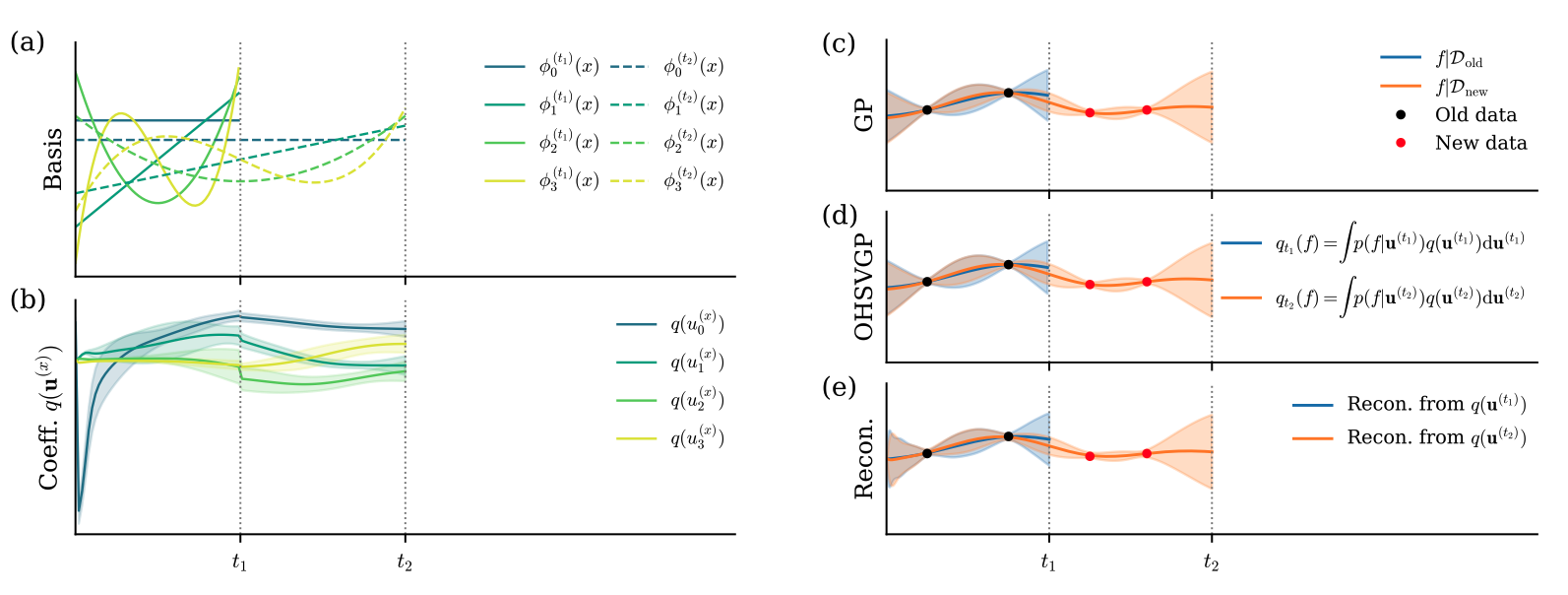
Chen et al. Recurrent Memory for Online Interdomain Gaussian Processes. NeurIPS 2025
24
Chen et al. Recurrent Memory for Online Interdomain Gaussian Processes. NeurIPS 2025
Bui et al. Streaming Sparse Gaussian Process Approximations. NIPS 2017
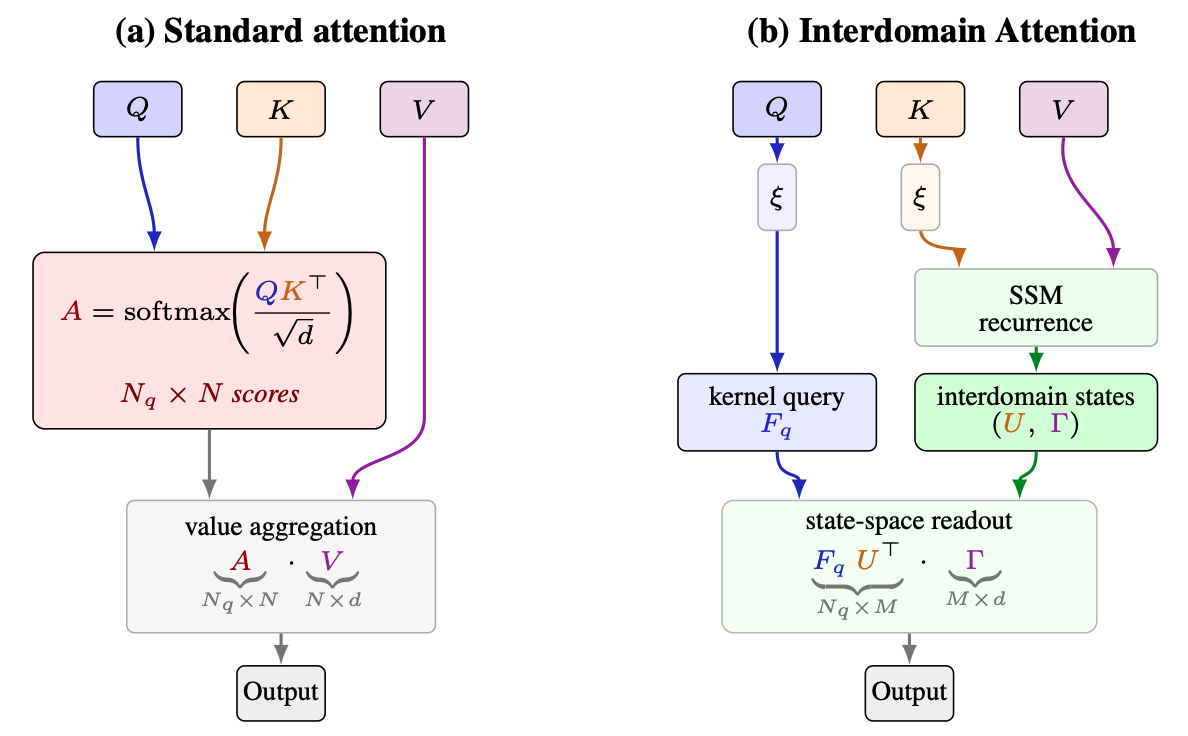
KV cache ⇔ growing number of data-space inducing points
Recurrent memory ⇔ interdomain inducing points (fixed state dim. = fixed #basis)
25
Kiyohara et al. Interdomain Attention: Beyond Token-Level Key-Value Memory. In submission
26
Kiyohara et al. Interdomain Attention: Beyond Token-Level Key-Value Memory. In submission
Yang et al. Gated Linear Attention Transformers with Hardware-Efficient Training. ICML 2024
Gu et al. On the Parameterization and Initialization of Diagonal State Space Models. NeurIPS 2022
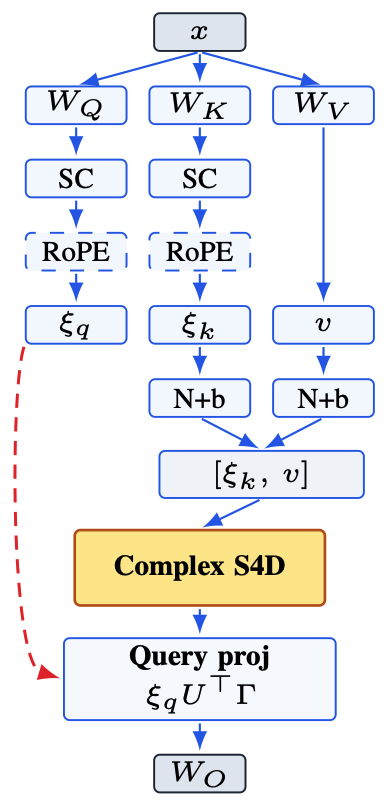
Practical Implementation (with deep learning magic 🪄)
1. Kernel feature: + RoPE
Tried RFF with (learnable) frequencies, didn’t work well
2. Apply RMSNorm to and before entering the recurrent memory
Mainly to stabilise the recurrent memory updates
in SVGPs are “free parameters” anyway
3. Complex S4D as the recurrent memory module
Several gating and selective update mechanism tried
4. Optional: construct from input with non-linear projection
Combined with (2): the kernel now becomes asymmetric
Extensive amount of engineering for GPU kernel implementations!
(our implementation is still sub-optimal even with chunking)
27
Kiyohara et al. Interdomain Attention: Beyond Token-Level Key-Value Memory. In submission
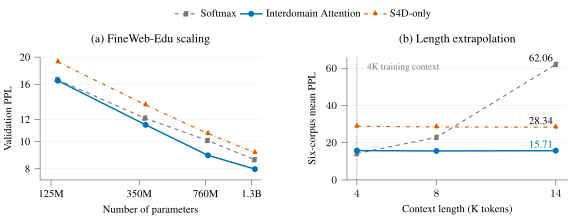
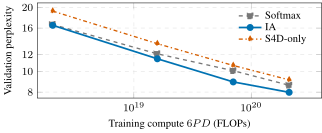

Perplexity = exp(avg. NLL)
28
Kiyohara et al. Interdomain Attention: Beyond Token-Level Key-Value Memory. In submission

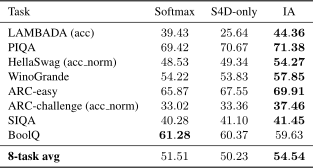
Downstream tasks (reasoning) performance
29
Kiyohara et al. Interdomain Attention: Beyond Token-Level Key-Value Memory. In submission
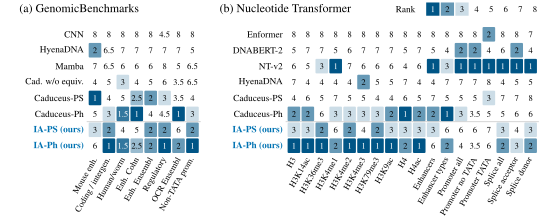
Downstream tasks performance
30
Kiyohara et al. Interdomain Attention: Beyond Token-Level Key-Value Memory. In submission
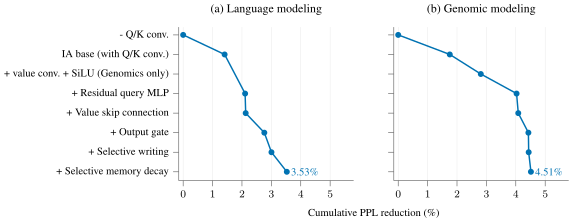
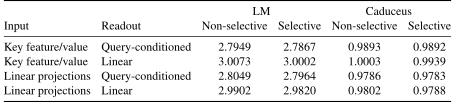
Query-conditioned read-out
is the main improvement factor
Some deep learning magic 🪄
also helps
Recurrent memory interdomain inducing points
So can think about how GP methods inspire memory design
Think about sequence layers as online learners
Now can think about network layer design in a “statistical modelling” way!
Bayes can already say quite something for NN design:
“knowledge adaptation” online learning + memory management
31
Engineering & MLSys work may feel less “pleasant”:
We had to throw away some “elegant ideas”
But what if: hardware info should enter in your “prior beliefs” of models?
Kiyohara et al. Interdomain Attention: Beyond Token-Level Key-Value Memory. In submission
What Would Bayes Do
for Next-Gen Neural Network Design?
Uncertainty quantification?
Memory updates & maintenance?
Maximally “squeezing” out the “value” of each token?
How to build a hierarchy of features?
Your thoughts?
Thank you!
Innovations are from my great students, errors are mine :)
Questions? Ask now, or contact
PhD & Postdoc positions available on Bayesian deep learning
Naoki Kiyohara
Harrison Bo Hua Zhu
Riccardo El Hassanin
Wenlong Chen